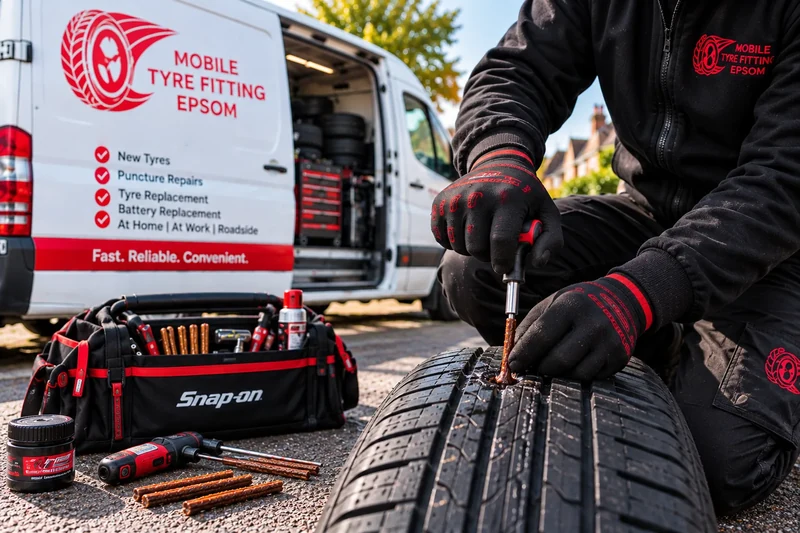
We come to you
Driveway, office car park or the hard shoulder of the A24. Wherever the car stopped.
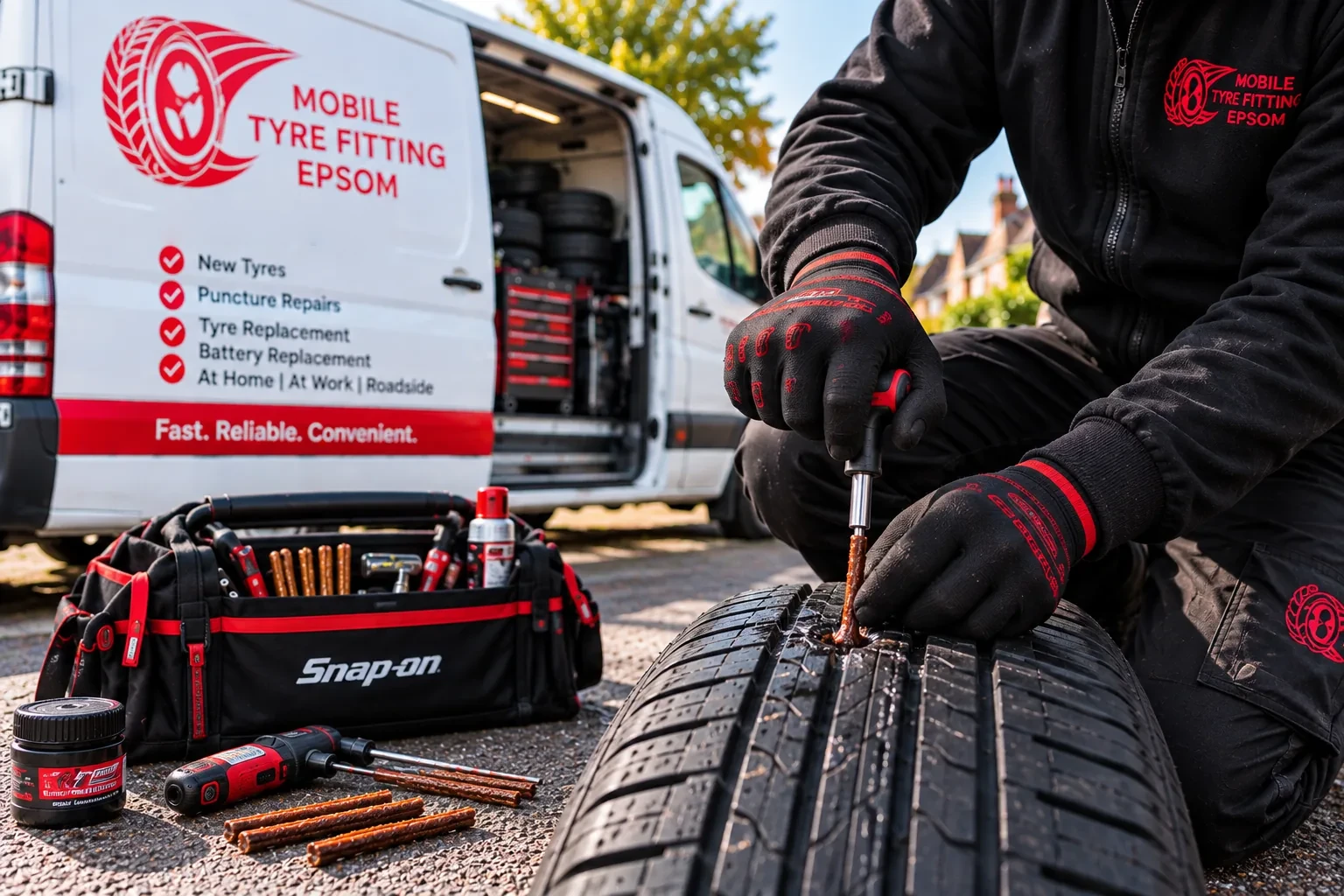
Find the real fault first
Not every tyre losing air has a nail in it. We diagnose the actual cause, whether that is the valve, the rim seat, a sensor seal or the casing itself, then fix the right thing.
Overview
Drivers come to us convinced they have a puncture because the car needs topping up every fortnight. Quite often there is no nail anywhere in the tyre. A tyre can lose pressure through a perished rubber valve, through corrosion on the rim where the bead seats, through a leaking TPMS sensor seal, through a cracked or buckled wheel, or through the casing itself.
That is why this service is diagnostic before it is mechanical. We pressure the wheel and test it properly rather than glancing at the tread, because a bead-seat leak or a valve seep is invisible until you look for it.
This is also the service where we make the repair-or-replace call on more complicated damage: kerb tears, cuts you are not sure about, vibration after hitting a pothole on Kiln Lane, or a tyre that was run flat for a mile before you realised.
What's included
Five common causes of a tyre that will not hold pressure, and what each one needs.
Rubber valves harden and crack with age and UV.
Alloy wheels oxidise where the tyre bead sits, especially on cars that see winter salt.
The sensor's grommet and nut seal perish.
Found by water test, then plug-and-patched if it is in the zone.
Buckled rims, kerb cuts and sidewall bulges.
A pothole strike can throw a wheel out of balance or bend it.
Step by step
Working from the cheapest and most likely cause to the most expensive, so you are not paying for the wrong fix.
Starting figures across all four, checked against the door pillar plate.
The most common and cheapest causes first.
A casing leak means the tyre comes off, so the liner can be read.
Valve, sensor kit, rim reseal or a repair, then balanced and torqued.
When to call
If any of these describe your car, the problem will not fix itself.
A steady, repeatable loss.
The system is telling you that wheel is losing pressure faster than the others.
Usually a thrown balance weight or an impact-bent rim rather than the tyre itself.
Fast enough to hear means fast enough to leave you flat overnight.
Cost and detail
We diagnose first and quote the specific fix, so you are not paying for work the car does not need.
Scope
The dividing line, stated plainly.
Why us
Patching a rim leak wastes your money and still loses air.
A valve costs a fraction of a repair, a repair a fraction of a tyre.
If we do not trust the tyre, we say so, and we explain exactly why.
Bead breaker, changer and balancer on board, so the tyre comes off.
Diagnosis and repair happen in one callout wherever the parts allow.
You get told what was wrong and why, not just handed a bill.
Where we work
We carry out mobile tyre repair throughout Epsom and the surrounding areas.
Questions
Straight answers to what customers ask before booking.
Very likely one of four things: a perished rubber valve, corrosion on the alloy rim where the tyre bead seats, a leaking TPMS sensor seal, or a small casing porosity.
Puncture repair is the specific job of sealing a tread injury with a combination plug-and-patch.
A healthy tyre loses roughly one to two psi a month through normal permeation, and pressures also drop about one psi for every five and a half degrees the temperature falls.
Yes, in most cases. That is a bead-seat leak, usually caused by corrosion on an alloy rim.
Either one tyre genuinely is losing pressure faster than the others, or a sensor has failed. TPMS sensors have an internal battery that typically lasts seven to ten years and cannot be replaced separately.
If the tread is well above 3mm and the casing is under about six years old, usually yes.
No, and we would not attempt to on the roadside. A cracked alloy is a structural failure and a buckled rim needs specialist straightening equipment.
Yes. We run twenty four hour callouts across Epsom, Ewell, Ashtead, Stoneleigh, Epsom Downs and Epsom Common.
Keep exploring
Other work we carry out at your address across Epsom and Surrey.
Losing air?
Describe the symptom and we will tell you the likely cause before we arrive, so you know roughly what it will cost.
Answered 24 hours a day, every day of the year.